This calculator is for the NSW Peak Demand Reduction Scheme battery incentive (PRCs).
Estimate the Peak Reduction Certificates (PRCs) a battery earns under the NSW Peak Demand Reduction Scheme (Amendment No. 3 Rule 2026, made 7 September 2026), the incentive quoted loosely as “NESC”. Pick a site type, enter the battery size and you have an indicative install discount in seconds.
What is the site?
Detected activity: BESS4 · Small–medium business · 20–200 kWh usable
Nameplate capacity. The scheme counts 90% as usable.
AC output. Caps the incentive at 4h × inverter.
Optional: 0 = battery-only (base rate). Within 90 days it must be ≥ ¼ of usable capacity.
Is this for your own site, or do you run a solar business?
Solar panels alone do not earn PRCs. Midday generation does not reduce the evening peak. It is the battery discharging into the 2:30–8:30 pm peak window that creates PRC value. The panels themselves earn federal STCs. Try the STC calculator.
Estimate only. Final PRC volumes, product eligibility and certificate prices are determined by IPART methods and your Accredited Certificate Provider. On the Ausgrid network the calculation uses a network loss factor of 1.04.
How PRCs are calculated
Under the NSW Peak Demand Reduction Scheme (part of the Energy Security Safeguard, regulated by IPART), a battery earns Peak Reduction Certificates for the capacity it can reliably shift out of the summer evening peak. The rule takes the usable capacity (90% of nameplate), applies an activity coefficient, then multiplies by the 6-hour peak window, the equipment lifetime and the network loss factor. One certificate is created per 0.1 kW of peak demand reduction capacity, so the count is Peak Demand Reduction Capacity × Network Loss Factor × 10, rounded down. The value is deemed upfront and delivered as an install discount.
Model this rebate into a real system
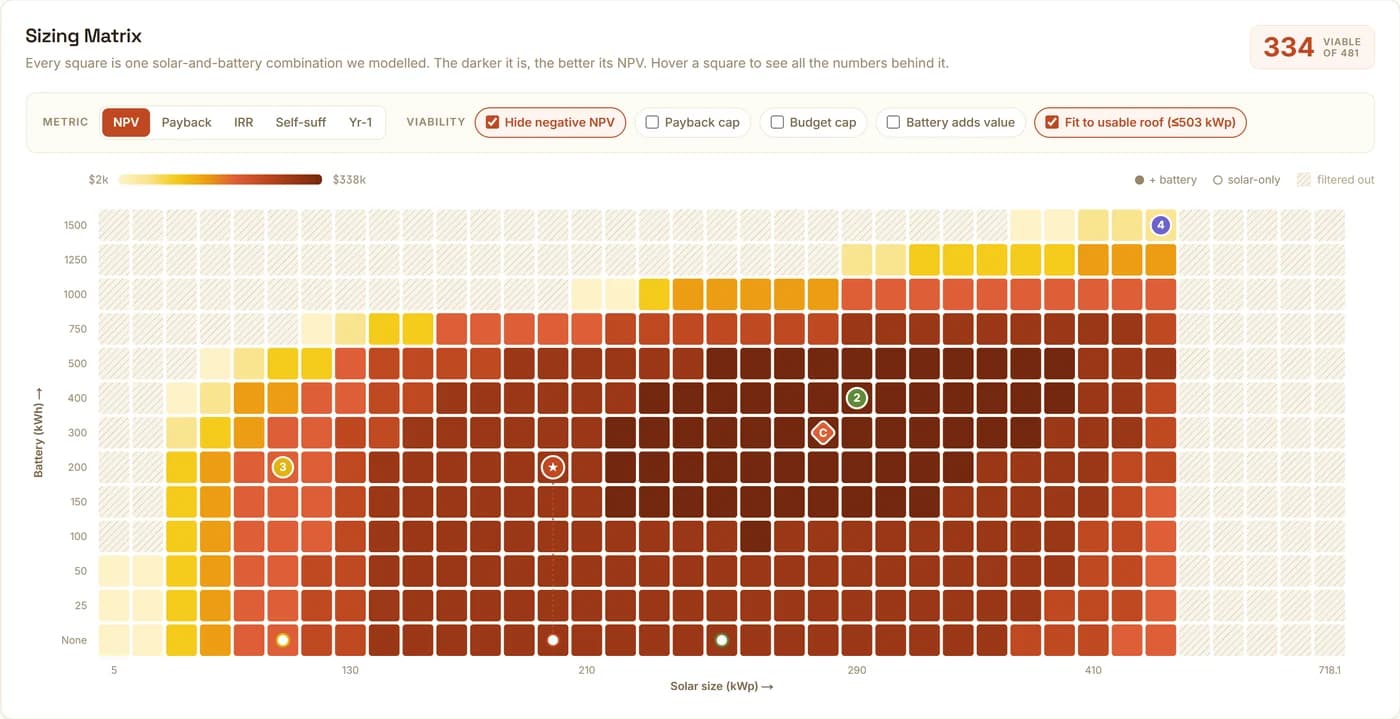
The number above is one cell. Amperage models every solar and battery size against the site’s actual load and tariff — payback, NPV, IRR and self-sufficiency — with the PDRS rebate and STCs already priced in, then stars the size that wins. It’s how solar companies and energy consultants size a job and put a proposal in front of a customer.
The Amperage sizing matrix — every size modelled, the best one starred.
The NSW Peak Demand Reduction Scheme runs five battery activities (BESS1 to BESS5). The right one is set by your site type and battery size. Rates below are the demand-shifting coefficient in kW per kWh; where two are shown, the first is the higher solar-route rate.
Activity
Best for
Capacity
Rate (kW/kWh)
Starts
BESS1
Home (suspended: HESDP / govt sites only)
2–28 kWh usable
0.0853
1 Jul 2026
BESS2
Existing battery, demand response
2–50 kWh usable, first 28 kWh counted
0.0734
1 Jul 2026
BESS3
Apartment building (4+ dwellings)
20–200 kWh usable
0.12 / 0.0853
1 Sep 2026
BESS4
Small & medium business
20–200 kWh usable
0.10 / 0.067
1 Sep 2026
BESS5
Commercial & industrial
200 kWh–30 MWh usable
0.10 / 0.067
1 Sep 2026
Frequently asked questions
What is the PDRS?
The NSW Peak Demand Reduction Scheme (PDRS) is part of the Energy Security Safeguard, regulated by IPART. It issues Peak Reduction Certificates (PRCs) for cutting demand during the summer evening peak. Batteries earn PRCs through the BESS1 to BESS5 activities set out in the Peak Demand Reduction Scheme (Amendment No. 3) Rule 2026, made on 7 September 2026.
Is the PDRS the same as the NESC?
No. There is no NSW scheme literally called the NESC; the label is used loosely for the NSW Energy Security Safeguard, which runs two schemes: the Energy Savings Scheme (ESCs) and the Peak Demand Reduction Scheme (PRCs). This calculator covers the PDRS battery activities.
Which activity applies to my project?
BESS1 covers homes (2 to 28 kWh usable) but is suspended: no PRCs for home batteries installed after 30 June 2025, except from 1 July 2026 through the Home Energy Saver Discounts Program or at a government owned and managed site. BESS2 onboards an existing battery for demand response, BESS3 covers apartment buildings of four or more dwellings, BESS4 covers small and medium businesses (20 to 200 kWh) and BESS5 covers commercial and industrial sites (200 kWh to 30 MWh). The calculator detects the activity from your site type and battery size, so you never need to know the codes. BESS3 to BESS5 commence 1 September 2026; BESS2 from 1 July 2026.
How are PRCs calculated?
The rule takes the usable capacity (90% of nameplate), applies an activity coefficient to get the peak demand shifting capacity in kW, then multiplies by the 6-hour peak window (2:30 to 8:30 pm), the equipment lifetime (15 years, or 6 for BESS2) and the network loss factor for your distribution network. One certificate is created per 0.1 kW of peak demand reduction capacity, so PRCs = Peak Demand Reduction Capacity x Network Loss Factor x 10, rounded down.
Is the PRC value upfront or annual?
Upfront. The PRCs are deemed over the whole equipment lifetime and created once, so the value is a single upfront amount, not a yearly payment. It reaches the customer as an installation discount through an Accredited Certificate Provider.
Does solar earn PRCs, and do I need to install new solar?
Solar panels alone do not earn PRCs; midday generation does not reduce the evening peak. It is the battery discharging into the 2:30 to 8:30 pm peak that earns PRCs, and the panels earn federal STCs separately. For BESS4 and BESS5, a battery installed within 90 days of new solar earns the higher coefficient (0.10 instead of 0.067), but only if that new solar is at least a quarter of the usable battery capacity. Under a quarter within 90 days, the battery earns no PRCs at all. A battery installed more than 90 days after the solar, or with no new solar, earns the 0.067 rate with no ratio test. BESS1 (home, currently suspended) instead requires solar at the site.
Why does the battery inverter size matter?
The battery inverter output is the AC capacity, and it does two things. It caps the incentive at four hours times the inverter (so an undersized inverter lowers the PRC count), and for the business activities the usable capacity must not exceed six times the inverter output or the battery is not eligible. Sizing the inverter correctly protects both the eligibility and the value.
What else do I need to claim, beyond the numbers?
A minimum customer contribution (at least $200 for BESS1, $1,000 for BESS3, $5,000 for BESS4), an approved battery product and accredited installer, all network and planning approvals, and the correct install date window. BESS4 and BESS5 can only be claimed once per site, and BESS2 needs a 12-month VPP or aggregator contract with at least 6 years of warranty remaining.
Do I need a VPP contract to claim the battery rebate?
Only for BESS2, the pathway that onboards an existing battery for demand response, which needs a 12-month VPP or aggregator contract. For BESS1, BESS3, BESS4 and BESS5 (new batteries) there is no VPP contract requirement; the battery only has to be internet-connectable and controllable by a demand-response aggregator. That is a hardware capability, not a signed contract, so it applies equally to home, apartment, small business and C&I batteries.
How much is a PRC worth?
PRC prices float with the certificate market; the calculator starts from the current market default Amperage quotes with, which you can adjust under More options. Confirm the current value with your Accredited Certificate Provider before quoting a firm discount.